


胶水话题博客
Metal buildings are engineered for durability, but their long-term performance depends on the effective sealing at every critical joint. Poor sealing can compromise an otherwise well-designed structure.
By incorporating butyl sealants and tapes into roof and wall assemblies, contractors and building owners can extend longevity, reduce maintenance costs, and improve overall weather resistance. With unmatched adhesion, permanent flexibility, and proven performance in demanding conditions, butyl sealants and tapes are a key component in the future of metal construction.
Common challenges of metal building
Metal buildings are continuously exposed to the elements. Over time, environmental stresses can lead to leaks, corrosion, and structural damage if vulnerable areas are not properly sealed.
Common problem areas include:
- Panel overlaps and seams
- Ridge caps and end laps
- Gutter, trims and flashings
Water infiltration
Water intrusion remains the most common cause of metal building deterioration. The seams, fasteners, and penetrations are potential entry points that allow moisture and wind-driven debris into the building envelope. Left unsealed, moisture can seep into the gaps, leading to rust, insulation degradation, interior leaks, and mold growth.
Thermal movement
Metal expands and contracts with temperature changes. Over time, this constant movement can cause fasteners to loosen, seams to shift, and gaps to develop—leading to air leaks, water penetration, and long-term structural deterioration.
Weather-related stress
High winds, heavy rain, snow, and ice buildup place additional stress on joints and fasteners. Without an effective, flexible seal, these forces can accelerate wear and allow moisture infiltration, leading to long-term damage.
Effective sealing is essential to maintain structural integrity, efficiency, and service life. This is where butyl-based products provide a distinct advantage.
What are butyl sealants and tapes?
Butyl sealants and tapes are non-hardening sealing materials formulated to provide long-term protection against water, air, and corrosion. Butyl offers permanent flexibility, strong adhesion, and superior weather resistance, making it an ideal solution to address key vulnerabilities in metal buildings.
Butyl sealants are non-hardening, paste-like materials applied with a caulking gun. They remain flexible and tacky, making them ideal for dynamic joints and irregular surfaces.
Butyl tapes are re-formed strips of butyl rubber provided in roll form on a release liner. They are pressure-sensitive and easy to apply. Perfect for clean, consistent sealing in panel overlaps and flat joints.
Both products are made from butyl rubber, a synthetic elastomer known for its:
- Superior adhesion: to metal substrates (galvanized steel, aluminum, coated panels)
- Weather resistance: withstands UV, rain, snow, and temperature extremes
- Movement accommodation: handles thermal expansion and contraction
- Long-term flexibility: non-hardening, doesn’t crack or shrink like some other sealants
- Ease of application: clean, fast, and consistent installation, with no mixing required
The role of butyl sealants and tapes in metal building protection
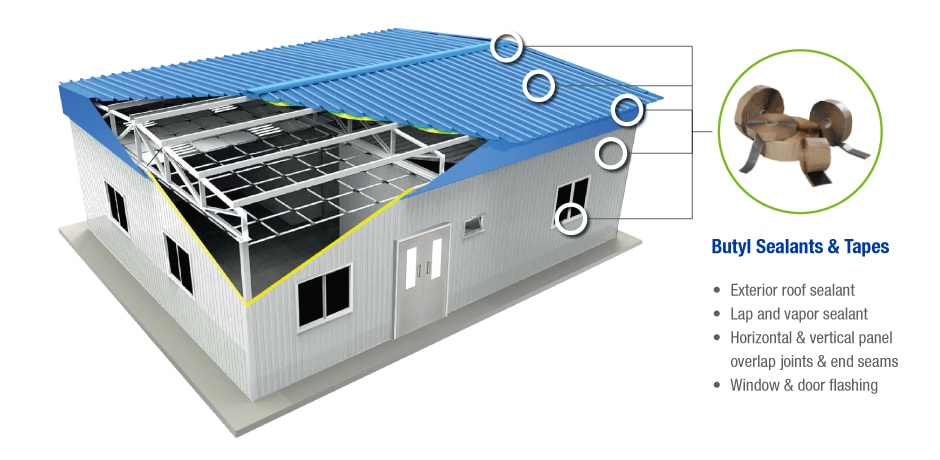
Butyl sealants and tapes are used throughout the building envelope, to protect critical interfaces:
Sealing panel overlap joints and seams
Metal building panels often have overlapping seams, which are vulnerable to water penetration. Butyl sealants and tapes fill gaps and seal edges, ensuring no moisture seeps through and a watertight bond between metal sheets. The adhesive properties allow it to remain fixed to the substrates, while its cohesive properties allow it to stretch with unwanted movement.
Gutter, trim and flashing sealing
Metal gutters, trims and flashings are prone to leaks and water damage over time. Butyl effectively adheres to metal and other surfaces, providing an airtight and watertight seal around these areas and preventing leaks at the joints.
Ridge cap and end-lap seals
Ridge caps and end laps are constantly exposed to wind-driven rain and snow. Butyl sealants and tape provide extra reinforcement to keep moisture out and protect roof edges.
Unlike rigid sealants, butyl adapts to building movement, conforms to irregular surfaces, maintains consistent sealing pressure, and continues to perform in extreme conditions.
Real-world impact: enhancing building envelope performance
By sealing gaps and joints effectively, butyl sealants and tapes contribute to overall building performance, including:
- Improved energy efficiency by reducing air leakage and thermal bridging
- Lower maintenance costs through preventing water damage and corrosion
- Extended building lifespan by protecting structural components from the elements
- Better indoor comfort by minimizing drafts and moisture intrusion
Choosing the right butyl sealant or tape
Choosing the right butyl sealant or tape depends on the specific application, environmental conditions, and performance requirements.
Identify where and how the sealant or tape will be used
- Use butyl tape for clean, uniform surfaces like metal panel overlaps and gutter joints.
- Use butyl sealant for irregular joints, penetrations, or areas requiring tooling and shaping.
Select the right format and size
- Tape: Choose the appropriate width and thickness.
- Sealant: Consider viscosity and application method.
Check surface compatibility
- Butyl adheres well to metal. Adhesion testing is recommended for galvanized, coated, or painted metal substrates.
Proper installation is just as important as product selection. For best practices for installing butyl sealants and tapes, refer to our article: Everything you Need to Know about Butyl Sealants and Tapes.
Ready to upgrade your sealing system?
A global leader in adhesive and sealant technology, H.B. Fuller is driven by the power of collaboration. As your building and construction partner, we work side by side with you to add value across your entire supply chain. Backed by decades of research, hands-on problem-solving and on-site technical expertise, we make adhesive and sealant technology straightforward, predictable, and simple to work with.
Contact us today to learn how our butyl solutions can enhance the performance and longevity of your next metal building project.
博客分类
档案
- 2026
- 2025
- 2024
- 2023
- 2022